The Bulletin Board Replaced the Front Page: How One Town's Listings Became Its Only News
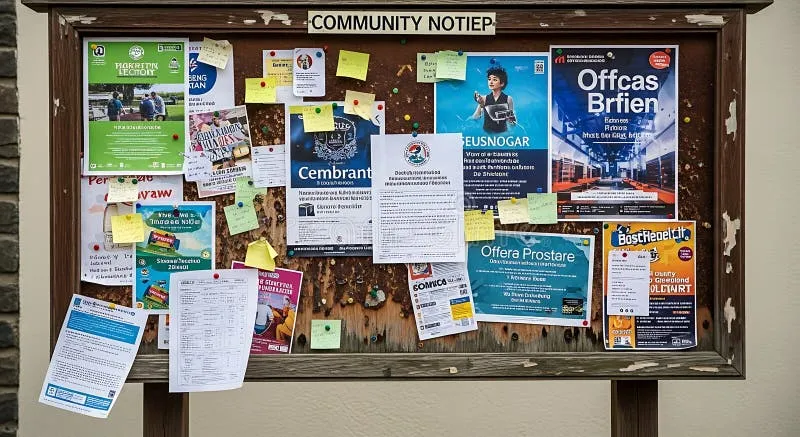
Photo: rural community bulletin board corkboard with handwritten flyers small town, via thumbs.dreamstime.com
The last print edition of the Courier landed on doorsteps in March, thin as a church bulletin and about as cheerful. The paper had served the county for ninety-one years, and when it folded, the obituary run was four names long. Nobody in the newsroom — by then, a single editor and a part-time typesetter — had a plan for what came next.
Turns out, the community did.
It started with the listings page. The Courier's classifieds had always been the most-read section anyway, the way they are in most small papers. Within weeks of the closure, a local woman named Darlene started a community board — first a Facebook group, then a printed weekly sheet she photocopied at the feed store. It was structured exactly like the classifieds section that had disappeared: used tractors, hay for sale, a lost heeler mix named Buck. But between the listings, other things started appearing.
"Voting Tuesday, fire hall, 7 a.m. to 7 p.m." — posted under a riding mower listing.
"Funeral for Earl S., Thursday at the Methodist church, potluck after." — sandwiched between a freezer chest and a litter of Lab puppies.
The Classifieds Were Always the Real Newspaper
Ask anyone who's worked at a small-town paper what section people actually read, and they'll tell you: the classifieds. The front page told you what happened. The classifieds told you what was happening — who was selling, who was hiring, who had died, who had something to give away.
There's a reason for that. A classified ad is a declaration of existence. "I'm here. I have this. I need that." Multiply that by a few hundred posts and you get something a front page can't replicate: a running pulse of a community's daily life.
So when the papers die and the listings survive, the listings don't just fill a gap. They become the town's operating system.
What Lives Between the Tractor Ads
Spend an afternoon scrolling through a rural community board — any of them, pick a state — and you'll find a strange civic collage:
- A combine for sale, $8,500 OBO
- The county commission meeting agenda, posted by a volunteer
- Free firewood, you haul
- A reminder that property tax payments are due
- Someone's grandmother's estate sale, three generations of furniture
- A school levy vote, explained by a retired teacher
That last category is the one that should make you pause. Election information, levy explanations, meeting notices — the stuff that used to be legally required public notices in a newspaper of record — now lives next to a post about a used chest freezer. There's no editor deciding what's important. There's no reporter verifying the levy numbers. There's just Darlene, moderating, and the general goodwill of a few hundred neighbors.
What Gets Lost in the 'For Sale' Feed
Here's the honest tension: this system works, and it's also fragile.
It works because classifieds were never really about commerce. They were about visibility. When the paper folded, the community didn't lose its news — it lost its filter, and it turns out the filter was replaceable. Neighbors self-organize. They flag scams, they correct each other's facts, they show up to the funeral because they saw the post between the hay listings.
But something does get lost. Nobody's asking the hard questions. When the county commission quietly votes to sell off public land, there's no reporter in the room — just whoever thought to post about it, and whoever saw the post in time. A community bulletin board, digital or paper, is a mirror. It reflects what people choose to share. It doesn't dig.
And there's the reach problem. The folks without smartphones — and every rural town has them — simply drop out of the record. Darlene's photocopy sheet at the feed store is her answer to that, a low-tech bridge that's more effective than it has any right to be.
A New Kind of Civic Infrastructure
The folks who study local news — and there's real research on this — have found that when a paper folds, voter turnout drops, split-ticket voting drops, and municipal borrowing costs go up. The classifieds board doesn't fix any of that. But it does something else important: it keeps the habits of civic life alive. The muscle memory of checking in, of knowing your neighbors' business, of having a shared place where the town talks to itself.
Maybe that's the real lesson here. We spent decades assuming journalism was the load-bearing wall of local community. It might have been the classifieds all along — the humble, unglamorous listings page where people said who they were and what they needed, and trusted the town to answer.
The front page is gone. The bulletin board, somehow, endures. And in a lot of American towns, that's the whole story — told one post at a time, right between the freezer chest and the Lab puppies.