Two Guys, a F-150, and a $40 Bill: Inside America's Help-Wanted Hauling Economy
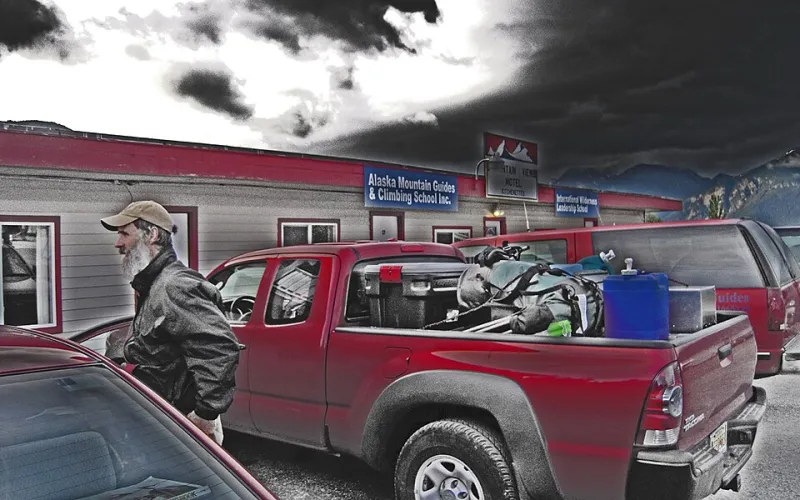
Photo: D. Sikes, CC BY-SA 2.0, via Wikimedia Commons
Scroll far enough through any local listings board in America and you'll hit a wall of them: MAN WITH TRUCK — MOVING/HAULING/JUNK REMOVAL — CHEAP RATES — CALL OR TEXT. No logo. No website. Sometimes no punctuation. Just a phone number and a promise.
These ads are the workhorses of the classifieds world — unglamorous, endlessly reposted, and somehow always in business. Behind every one of them is a pickup truck, a dolly, a set of ratchet straps, and a person who has quietly learned more about American basements than any therapist ever will.
We spent time with three haulers to figure out what this economy actually runs on. Turns out it runs on cash, couches, and a surprisingly strict rulebook nobody ever wrote down.
The $40 Benchmark
Ask any hauler what a job costs and you'll get the same shrug: it depends. But there's a gravitational center to the market, and it sits right around forty bucks a trip.
"Forty is the magic number," says Denny, who's been running hauls out of a 2004 Silverado in central Ohio for six years. "A couch across town? Forty. A fridge to the dump? Forty, maybe fifty if it's up stairs. You go under that and you're working for gas money. You go way over and they call the big companies with the wrapped trucks."
That's the tightrope. The branded junk-removal franchises quote by volume and send estimates that start at $150. The guy with the truck undercuts them on everything, and his whole business model lives in that gap. He's not cheaper because he's faster. He's cheaper because his overhead is a tailgate and a Craigslist-level ad.
The Cryptic Jobs
Every hauler has a folder of stories that start the same way: "Heavy item, needs two people. Will explain when you get here."
They never explain when you get here.
Miguel, who works weekends out of a Tundra outside Fresno, has learned to treat those listings like a mystery novel. "One time it was a pool table. Fine. One time it was a safe that turned out to be bolted through the foundation. Not fine." Another time, he swears, it was a full-size arcade cabinet that had to come down a spiral staircase. "We got it down. Don't ask how. The banister didn't make it."
The veterans develop rules. Ask if there are stairs. Ask if it fits through a door. Ask what "heavy" means — because to a customer, heavy is a treadmill; to a hauler, heavy is a gun safe. The good ones charge a stair fee, the great ones charge it without flinching, and the broke ones learn the hard way when a piano eats a full afternoon for the price of a pizza.
Estate Sales: The Endless Buffet
If couches are the bread and butter, estate-sale leftovers are the Thanksgiving feast. When a sale ends on Sunday afternoon, somebody has to make the leftovers vanish by Monday, and that somebody is almost always a hauler with a truck and a low opinion of sentimentality.
"I've hauled away nine treadmills this year," says Carla, who works estate cleanouts around Atlanta. "Nine. Nobody uses the treadmill. But you know what I never get? Good hand tools. Tools go first, always."
The unwritten deal at estate jobs is usually this: flat fee for the haul, plus whatever the truck can legally carry. Some haulers resell the salvage, some donate it, some just want the load gone. The smart ones know what a mid-century dresser fetches online and price their bids accordingly — sometimes offering to do the job nearly free if the furniture is good enough. The listings read like a bargain, but the real transaction happens at the dump's donation trailer.
The Risks Nobody Puts in the Ad
Here's what the ads don't mention: hauling is a genuinely risky line of work for a casual gig. Dropped dressers, tweaked backs, torn doorframes, and the eternal threat of the customer who says "just set it anywhere" then watches you set it somewhere wrong.
Insurance is rare. Contracts are rarer. The entire industry runs on a handshake, a Venmo screen, and the mutual understanding that everyone should take a photo before the straps come off. The haulers who last are the ones who text a picture of the loaded truck and one of the empty drop-off point. It takes ten seconds and prevents every argument.
And yet — the gig refuses to die, and refuses, mostly, to be app-ified.
Why the Apps Can't Kill It
There are apps for on-demand moving now. They take a cut, assign you a stranger, and route everything through a rating system. Some haulers tried them. Most came back.
"They wanted thirty percent," Denny says. "Thirty! For what? I already know everybody within twenty miles. My ad's been up on the board for four years. It's got a thumbtack made of reputation."
That's the real story. The man-with-a-truck economy survives because it's not really a logistics business — it's a trust business, run on repeat customers, church bulletin mentions, and the neighborhood group chat. The classifieds ad isn't marketing. It's a lighthouse. It just says I'm here, I'm local, and I've got straps.
So the next time you see one of those all-caps ads sandwiched between a lost cat and a riding mower, know what you're looking at: a one-person logistics network, forty dollars at a time, keeping America's basements navigable one heavy item at a time.